September 12, 2026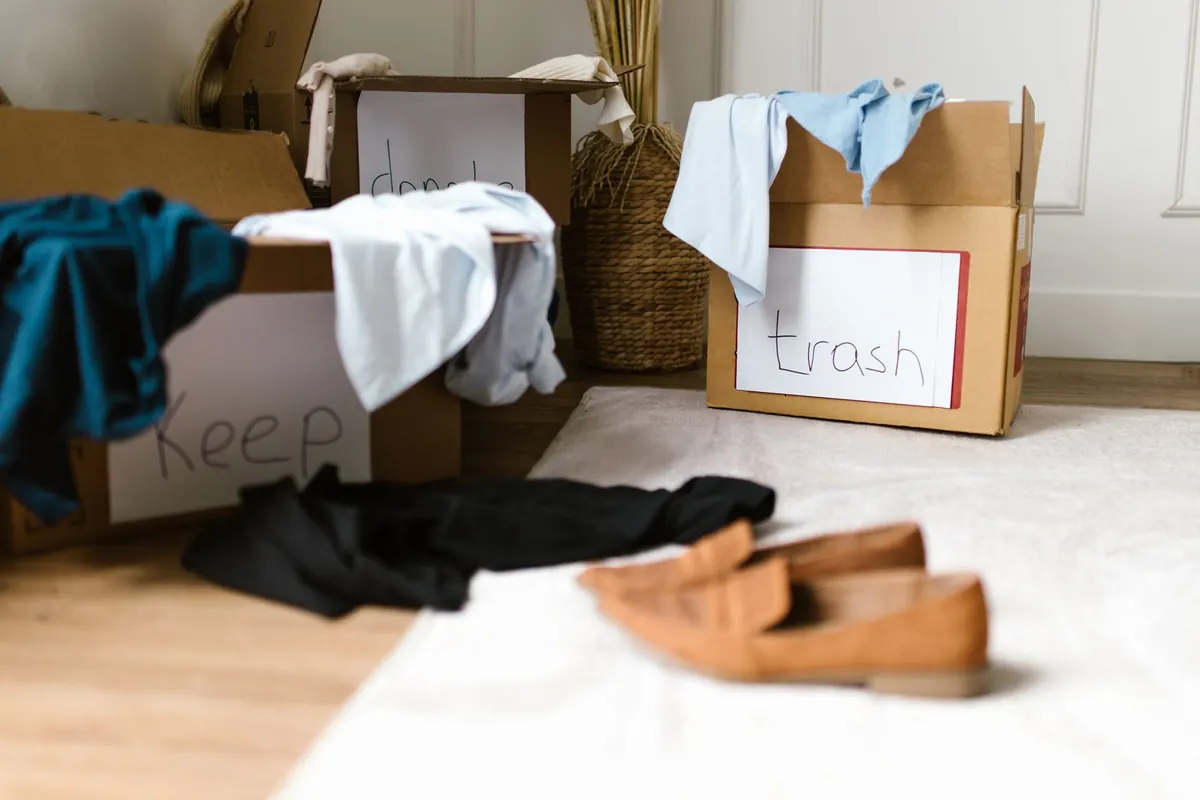
Decluttering a compact flat is a different job from decluttering a house. There is no loft, no garage, no spare room where the "not sure yet" pile can sit quietly until spring. Every bag you fill has to leave the building, which is exactly why a weekend is long enough — and why it needs a plan before you lift a single cushion.
What follows is a room-by-room weekend for a one-bedroom or studio flat, though it works just as well in a two-bed that has slowly filled up. Saturday for the kitchen and the main room, Sunday for the bedroom, bathroom and hallway. Deal with charity and recycling as you go rather than at the end, or you will spend Sunday evening sitting among bags you cannot face.
Before you start: Friday evening, one hour
Gather your kit the night before. It sounds fussy; it is the difference between starting at nine on Saturday and starting at eleven after a hunt for bin bags.
- Strong bin bags and two cardboard boxes that stack
- Reusable shopping bags or a folding crate for the charity run
- A marker pen and tape, so you can label "maybe" and "sell"
- Cleaning cloths, and a bin liner for whatever you find at the back of the cupboard
Then check three things, because they decide how quickly Sunday goes. What time your nearest charity shops accept donations. When your council's household waste recycling centre is open — many now need a slot booked in advance. And whether your council offers a paid bulky waste collection, which is usually the simplest route for a mattress or a broken chair.
The four-pile rule
Every item gets one of four destinations:
- Stays — it has a home here and you have used it in the last year.
- Relocates — it belongs in another room, or belongs to someone else.
- Leaves — charity, selling, or a friend who will actually use it.
- Rubbish — broken, worn out, expired, or beyond repair.
Nothing sits in the middle. If you genuinely cannot decide, it goes in one dated "maybe" box by the front door. If you have not opened that box in three months, it leaves unopened. One rule, hours saved.
Saturday morning: the kitchen
Kitchens in small flats hoard duplicates. Three cheese graters, five mugs you never choose, a drawer of takeaway menus and dead batteries. Empty one cupboard at a time onto the worktop and put back only what you have used this month. Be honest about the pan you keep meaning to season and the blender that was used twice.
Work through the fridge and freezer with a bin bag beside you, checking dates as you go. Unopened, in-date food you know you will not eat can go to a food bank collection point, often at a supermarket — check what the collection accepts before you turn up with a bag of odds and ends. Decant half-empty jars of spices and pasta into one container each; the shelf space you get back is surprising.
Under the sink, bin anything that has separated, gone solid or smells strange. Keep one all-purpose cleaner, one bathroom cleaner and one glass cleaner rather than a shelf of near-empties. Cleaning products should go to the tip or a council chemical collection, never down the sink or into general rubbish.
Saturday afternoon: the main room
This is where clutter is most visible and therefore most tiring, so work in categories rather than by furniture. Books first, then cables, then paperwork, then the chair where post and clothes quietly settle.
Cables are easy to fix. Keep one charger per device plus one spare, and put everything else in a bag for electrical recycling. Anything with a plug or a battery should not go in general waste.
Paperwork needs a firmer hand. Sort into three stacks: act on it, file it, shred it. Keep important documents — tenancy agreement, guarantees, insurance, anything to do with tax — in one labelled folder so it is never lost again. If you are unsure how long to keep financial or legal paperwork, check with the relevant organisation or a qualified adviser rather than guessing.
Clear surfaces last, not first. Shelves and drawers have to be sorted before the table can stay empty; otherwise the pile simply migrates back within a day.
Saturday evening or Sunday morning: bedroom and wardrobe
Tip the wardrobe out onto the bed and pick up each item. If it does not fit, does not suit you, or has not been worn in a year, it leaves. Be firm about the jeans that will fit one day and the shoes that hurt after twenty minutes. A useful test for the undecided: turn the hanger backwards, and if it is still backwards at the end of the season, it goes.
Bedding needs two sets per bed and perhaps one spare, not six. Under-bed boxes are for things you actually use, not for a second wardrobe. Anything needing repair goes into one basket with a deadline — if it is not mended within a week, it leaves, because in a small flat a repair pile becomes permanent furniture.
Sunday: bathroom, hallway and the drop zone
Bathrooms fill with travel minis and nearly empty bottles. Consolidate what you can, bin what has changed colour or texture, and take unused or expired medicines to a pharmacy for safe disposal — do not flush them and do not put them in the bin.
Old towels can go to an animal shelter or textile recycling. For the hallway, set up a drop zone that suits how you actually live: one hook per person, a tray for keys, a box for shoes, and a single place for post. Small flats go from tidy to chaotic mainly because paper has nowhere to land.
Getting it all out: charity, selling and the tip
Book the exit before you need it. Charity shops vary enormously — some welcome electricals, some cannot take them at all, and most have limited donation hours. Ring ahead before you load the car.
- Charity bags: clean, dry and only what you would happily give a friend. Ask about worn textiles; some charities sell unsellable clothing for ragging, others do not.
- Selling: photograph it, price it low, and set a 48-hour deadline. If it has not sold, it goes to charity. Take cash on collection and be wary of anyone offering to arrange their own courier.
- Recycling: batteries, electricals and anything with a plug go to the tip or a dedicated collection point, never the bin.
- Bulky items: use your council's paid collection service or take them to the recycling centre yourself, checking the rules first.
Whatever leaves must leave this weekend. The pile by the door is the enemy of a compact flat: it becomes a permanent feature, gets picked through, and quietly returns to the cupboards within a fortnight.
Keeping it clear without much space
Spend ten minutes each evening putting things back where they live; that single habit does more than any storage box. Adopt one in, one out — a new jumper means an old one leaves. Keep the dated maybe box, and do not buy storage until everything has been sorted, or you will simply organise clutter more neatly. Once a season, walk through with a bag and repeat the four-pile rule for an hour. In a small flat, that is usually enough to keep it feeling twice the size.
Photo: RDNE Stock project / Pexels